



Northern Vic farmers reap benefits of genetic improvements
Northern Victorian dairy farmers Frank and Marianne Kelly are reaping the benefits of making steady genetic improvements over the past decade, with genomics playing an important role.
Now milking 420 Australian Reds on their 500-hectare farm at Tragowel, south of Kerang, Frank and Marianne have switched breeds but always maintained a focus on breeding what’s best for their farming business.
Today they have fertile cows that are easy to calve with good udders and strong feet and legs to cope with long walks.
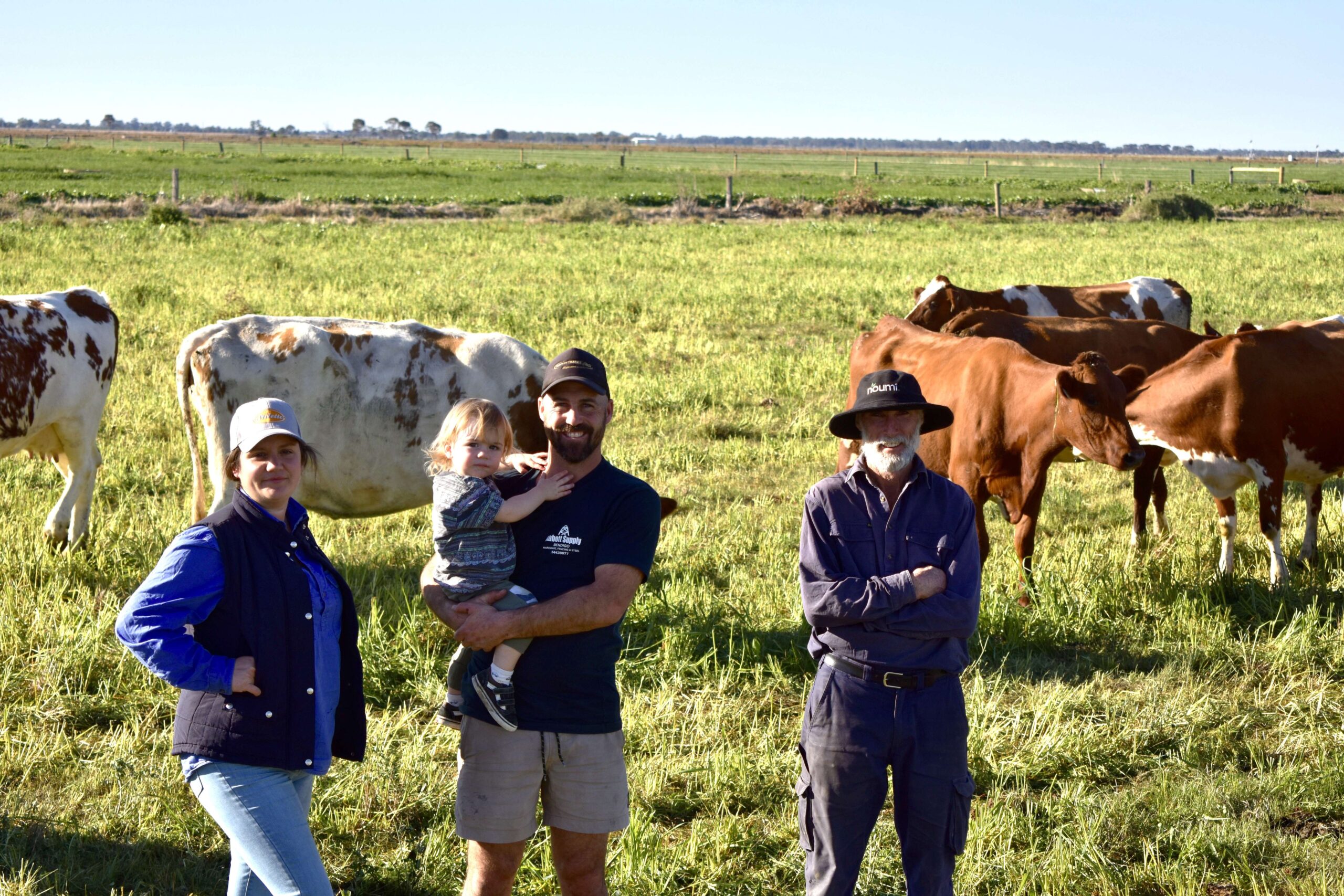
Frank Kelly (right) with his son Marty, daughter-in-law Courtney and grandson Alby.
Frank says the herd has never been in better shape and he’s not the only one appreciating the improvements.
The April 2026 ABV release confirms the quality of the Kelly herd which now ranks sixth in the Australian Red Breed for Balanced Performance Index (BPI), up one spot on its December 2025 ranking.
Over the past year, Frank and Marianne have placed their first bull, ARBDENNIS – Homedale Dennis, into the AI system and recorded the Top BPI Australian Red genomic heifer in the December ABV release with `4926’, a daughter of VIKRVESTY.
The success comes on the back of a multi-generation commitment to embracing breeding advancements and following a consistent breeding strategy.
Frank’s father Denis was a founding member of Victorian Artificial Breeders Co-op, the forerunner of Genetics Australia, and was among the first in the region to use artificial insemination. Frank continues to use new technologies and has been genomic testing all calves and heifers over the past four years.
“Dad got straight into AI when it started,” Frank said. “There were strong farmer discussion groups in those days and most of them thought AI was the future and they went straight into it. Dad was one of them which set us on a good path.”
The farm has been in the family for nearly 80 years and has continued to evolve, moving from Holsteins and Jerseys to straight Holsteins, to three-way crosses and about a decade ago settling on Australian Reds.
“We were looking to improve on fertility when we went with the Reds,” Frank said. “We’re really pleased with the herd and the direction it is going, the quality of the heifers and their durability and calving ease.”
Frank has been genomic testing all calves and heifers for four years and is starting to reap the rewards.
“We’re getting good solid results so we’re at the stage where we can select from the lower end of those heifers and move them on. We’ve got excess numbers each year but now we can breed from the best and go to beef with the rest.”
Those strong numbers allowed the farm to peak at 420 this year, up 20 on expectations. “We had plenty of heifers so we ended up milking a bigger herd and the season was good,” Frank said.
Frank consults genetics companies for breeding recommendations. “I don’t select which bull goes on which cow individually, we just pick a good team of bulls that have good udders and good feet and legs, the traits we most want to improve, and then we put them through the Genescreen and VIK Mate programs and decide which one of the team will be best suited to each cow and stick to that as we AI. It’s a simple program.”
The current crop of calves and heifers continues to impress.
While `4926’ stood out in December 2025, the Kellys now boast three of the top five genomically tested Australian Red heifers, including “4926” who sits in second place after the recent April ABV release. Frank says the real test will be when she enters the herd. “She’s just a young heifer but I did pick her out and had a look at her after she came to the top. She’s nothing special at this stage but she’s a nice-looking animal and we’ll see how she goes as she comes into the herd.
Frank finds that highly ranked BPI cows perform well.
His ‘Winifred Denis’ bull (now known as ARBDENNIS) joined Genetics Australia’s Australian Red team last year and Frank hopes he will be the first of many in the AI system and will introduce more farmers to the breed. After the recent April ABV release, ARBDENNIS ranks 4th for BPI, 8th for Health Weighted Index (HWI) and 5th for Sustainability Index (SI).
“He hasn’t yet got the results on the ground but the GA guys say he is a good animal to handle and fairly productive.”
Frank and Marianne are not stud breeders and usually just assign a number to their cows but came up with the name ‘Winifred Denis’ to honour his parents. They have registered three animals for the AI system including ‘Winifred Denis’s’ dam, Homedale Froerup Winifred.
Frank hopes ARBDENNIS helps to increase Australian Red numbers, particularly as a stand-alone breed and not just in cross programs. He says the breed is heading in a good direction, maintaining health and fertility and re-focusing on production and dairy strength.
On the home farm he has selected to improve udders and says they’re getting better every year. “Feet and legs are also critical for us because they have to walk so far. If their feet and legs aren’t good, they’re going to struggle.”
They also breed for calving ease and fertility and are seeing good results. “It didn’t change instantly but as soon as I bred the black and whites to Reds, we spent a lot less time in the paddocks with them. Now they just have their calves and you go out the next morning and the calves are all healthy and running around,” said Frank.
For more information contact: DataGene 1800 841 848 or enquiries@datagene.com.au or www.datagene.com.au.
DataGene is an initiative of Dairy Australia and the herd improvement industry.